

Edition #89 | THE FIRST BARBED WIRE PATENT | Thursday, June 25, 2026
The best fixes come from studying the exact problem in front of you and adjusting what you already hold. Most people wait for better materials instead of refining the ones at hand.
Let's get into it.
1 Story
THE FIRST BARBED WIRE PATENT
On June 25, 1867, Lucien B. Smith stood in his Kent, Ohio workshop holding a length of smooth wire that had already failed him twice that morning. Livestock still roamed the unfenced prairie, trampling rows of young corn and sparking boundary fights between neighbors who had no cheap way to mark their land.
He had watched wooden fences rot within two seasons and thorny hedges take years to thicken. Wire seemed the only material light enough to string across miles, yet smooth strands let cattle push through without consequence. Smith began with the wire already on his bench.
He cut short segments, bent each end into a sharp point, then slid the pieces onto a main strand. At first he twisted them by hand, counting the turns against his thumb to keep spacing even. The barbs slipped under tension. The wire snapped when he stretched it tight between posts. He tried thicker gauges, then thinner ones, listening for the telltale ping that meant another break.
The wall arrived on a humid afternoon when a full strand sagged after a single rain. Every barb had slid to the lowest point, leaving long stretches of smooth wire that cattle simply leaned against. Smith sat on an upturned bucket and stared at the sagging line for an hour. Replacing the entire fence would cost more than he had saved from the last harvest.
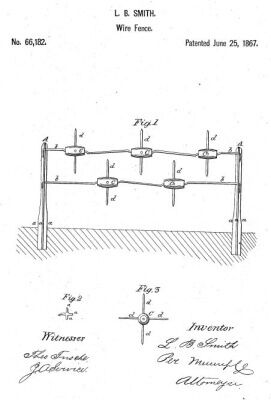
He decided to add a second component. He shaped small iron spools, drilled a hole through each center, and fixed four short spurs around the rim. The spools threaded onto the main wire and stayed in place because the spurs bit into the surface when pressure was applied. He tested the new sections by yanking them with both hands and then with a team of horses. Nothing moved.
U.S. Patent No. 66,182 described the exact arrangement: spools of iron or wood, each perforated and fitted with four spurs. Within months other farmers copied the pattern using blacksmith tools already hanging on their walls. The design scaled because it required no new equipment, only the wire and the habit of looking twice at the same materials.
Smith kept one sample coil in his barn for years after the patent was granted. He would run his fingers along the spurs when neighbors came asking how the fence held through another winter storm. The wire outlasted the farm itself and became the standard across the plains.
1 VERSE
Proverbs 24:30-32
“I went by the field of the slothful, and by the vineyard of the man void of understanding; And, lo, it was all grown over with thorns, and nettles had covered the face thereof, and the stone wall thereof was broken down. Then I saw, and considered it well: I looked upon it, and received instruction.”
The verse calls for close observation of what has broken down and then deliberate action with the materials already present. That kind of attention turns visible neglect into usable knowledge.
1 VOICE

Peter Thiel
“The best startups might be considered slightly less extreme kinds of cults.”
Peter Thiel wrote in Zero to One that lasting work begins with seeing one specific problem more clearly than others do. The same focus that builds a company can also refine an ordinary tool until it solves what everyone else accepted as permanent.
What single daily friction in your work are you still treating as unsolvable with the materials already in reach?